- Commercial Greenhouse
- Film Greenhouse
- PC Greenhouse
- Glass Greenhouse
- Tunnel Greenhouse
- Scientific Research Greenhouse
- Vegetable Greenhouse
- Flower Greenhouse
- Multi-span Greenhouse
- Sawtooth Greenhouse
- Greenhouse Equipments
- Greenhouse Accessories
- Hot Dip Galvanized Pipe
- Irrigation System
- Hydroponics System
- Planting Tools
- Planting technology
Tel: +86 191 5068 3942
Fax:
Mobile: +86 191 5068 3942
Contact: Alina
E-mail: sales@cngreenhouses.com
SKYPE:


Vegetable Film Greenhouse: Rotation, Span and Height
Vegetable film greenhouse planned for rotation, not one crop: 6.4-10 m spans, 4.3-6.5 m height, one or two film layers, heating, irrigation and benches.
.
TEL:+86 191 5068 3942
- Features


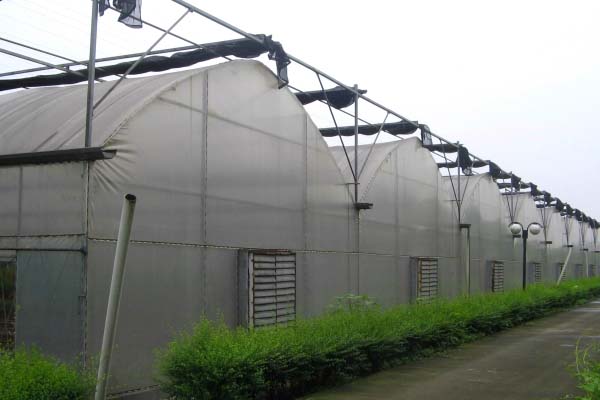
A vegetable grower does not buy a house for one crop. The house is bought once and then asked to carry a sequence: a seedling block, a leafy crop, a fruiting crop, a winter crop, a clean-out, and round again. The house itself does not change between those crops, because the span, the total height, the number of film layers and the installed systems were all fixed on the day the order was placed. That is the whole point of matching a rotation to a house type: the bay width and the headroom you order have to be able to carry every crop in the sequence, including the one you have not planned yet.
A Multi-Span House Is Rotated Bay by Bay
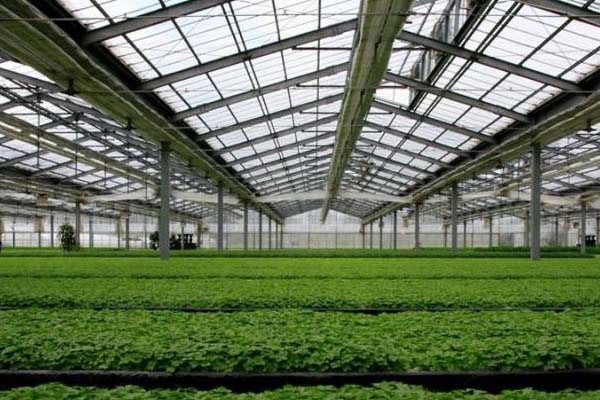
This is a multi-span film greenhouse. Its arch bay repeats across the width of the building, so the house is not one large span but a set of identical units joined along the roof, and that repeat is what a rotation can be hung on. Blocks of crop can follow the units: one block holding seedlings, the next carrying a crop in full production, the next being cleared and re-set, all at the same time and all under the same cover.
The same property decides how a grower talks to us about sizes. Because the bay is the repeating unit, the useful question is not the floor area of the whole house but how much clear width one unit should give, and how many of those units are wanted in a run. The reference layout for this model is 64 m by 40 m, an area of 2,560 square metres, described as middle scale - one worked example of that arithmetic rather than the only size the house can be built to.
Span: The Clear Width One Crop Block Gets
Spans of 6.4, 8, 9.6 and 10 metres are available, and the span is the clear width of one repeated unit. Within that width the grower has to fit two things: the growing strips the crop is planted on, and the route the harvest, the inputs and the workers travel along. The wider the span, the more of both can sit inside one unit; the narrower the span, the more units the same width of land is divided into.
For a rotation this figure is chosen once and then inherited by every crop, so it is worth choosing against the heaviest week in the year rather than the first crop on the list. A block that carries a low, dense leafy crop is easy to lay out; the same block carrying a fruiting crop that has to be picked repeatedly needs room to move through it without walking on the crop, and the route occupies part of the same clear width. Buying span for the lightest crop and then rotating into the heaviest is the usual way a size decision turns out to be too tight.
Height: The One Choice a Later Crop Cannot Argue With
Total structure height runs from 4.3 metres to 6.5 metres. The bottom of that range is a house worked from the ground with a shallow volume over the crop; the top of the range is a house with a tall volume over the same floor. In a rotation the height is effectively set by the tallest crop in the sequence, because that crop comes back round every year: a plant grown up on strings, or one allowed to reach a full canopy, needs the volume above it for the whole of its cycle, not just at the end.
The reason this is worth more thought than any other line on the order is that there is no later adjustment. Span and height are ordered together and built into the structure, so a house ordered at the bottom of the range stays at the bottom of the range. A rotation that gains a trellised crop two seasons from now will have to grow it outside or not at all. If the sequence is expected to change, the top of the height range is the part of the order that buys the option.
Film Layers for a Rotation That Runs Through the Cold Months
The house is quoted as a single or a double layer of film, the covering material thickness is 0.15 mm or 0.12 mm, and the standard cover is a clear greenhouse film at 6 mil. Both layers are held in the same grooved channel frame with aluminium clips, so the layer count is a covering decision rather than a structural one.
A rotation answers this question more clearly than a single crop does. A sequence that stops in autumn can run under one sheet; a sequence that continues through the cold months is the case the second layer is bought for, because the air cushion between the two sheets is what prevents heat loss and cold air intrusion and keeps energy consumption low. The layer count is therefore read off the winter crop, which is the crop that carries the heating cost, and the summer crops simply inherit it.
Covering also has a place in the calendar between crops. Film is supplied cut to the length of the house on many styles, so a re-cover is ordered against the run of the house rather than against a roll size, and a grower who intends to renew the cover at a natural break in the rotation can plan that as a line in the year alongside the crop changes.
The Systems a Rotation Draws On
Six systems can be added to the frame, depending on the customer's request: cooling and heating, irrigation, ventilation, fertilization, shading and benches. Which of them a vegetable rotation actually leans on follows the calendar rather than the crop list. Irrigation and fertilization are the two that are in use in every rotation, because both are water lines run to the blocks and both are re-set when the blocks move. Heating is the winter-crop line, and benches are the seedling line at the head of the rotation, where the next crop is raised while the current one is still in the ground.
It is worth deciding the systems at the same time as the span, because they occupy the same clear width and the same service runs. The irrigation range is set out in the irrigation system range, the heating side is covered in the article on greenhouse heating requirements, and the remaining systems on the list are quoted with the house itself.
What Changes Between Two Crops, and What Does Not
Between two crops in the same house, less changes than a grower new to covered production expects. The frame stays exactly as ordered: hot dip galvanized steel pipe with an arch roof, a grooved channel frame along the arch and the walls, and the covering held in it by aluminium clips, a structure that also suits varied and complex topographic conditions and any type of landscape. Nothing about the building is dismantled at a crop change.
What does change is everything inside and on the cover. The growing strips are re-set to the next crop, the irrigation and fertilization lines are moved with them, trellis or support for a climbing crop goes up or comes down, and the film can be renewed if the cover is at the end of its working life rather than the crop. Because the bay repeats, one block can be emptied, cleaned and left to rest while the neighbouring blocks keep cropping, which is the practical advantage of running a rotation in this shape of house rather than in one open span.
Sizing the House Against the Whole Year
The house is listed for vegetable, fruit, flower and seed nursery work, materials are quoted as plastic and mesh, the design wind load is 0.35 kN/m2 and the export market is global. Vents are manually or electrically operated. All of that is the fixed part of the offer; the span, the height, the layer count and the systems are the part that is chosen, and every one of them is argued from the rotation rather than from a single season.
The order therefore works best written as a year rather than as a crop: the tallest crop in the sequence sets the height, the heaviest harvest week sets the span and the route inside it, the coldest month sets the layer count, and the blocks in between set how many units the run should have. The other houses built on this frame are collected in the film greenhouse range, and vegetable houses as a group, including the other structures used for the same crops, are in the vegetable greenhouse section. The multi-span film house for vegetables is described separately in the page on the multi-span film greenhouse for vegetables.
Why Us ?
We are the manufacturer specializing in greenhouses with above 35 years, and our greenhouses are exported worldwide. A professional engineer department stands behind every drawing, and if a customer requests it our engineers travel to the buyer country to guide the installation. Every year many customers visit the factory for business cooperation, and if you need help working a rotation into a span and a height, that is the conversation our engineers have most often before an order is placed.
Frequently Asked Questions:
Q: How is a vegetable rotation laid out inside a multi-span film greenhouse?
A: By following the repeating bay. Because the arch unit repeats across the width of the building, the blocks of the rotation can be placed in units rather than in one open floor: a seedling block, a block in full production and a block being cleared can sit side by side under the same cover. The span, the height and the systems are ordered once, and the blocks are re-arranged inside those limits at each crop change.
A: By following the repeating bay. Because the arch unit repeats across the width of the building, the blocks of the rotation can be placed in units rather than in one open floor: a seedling block, a block in full production and a block being cleared can sit side by side under the same cover. The span, the height and the systems are ordered once, and the blocks are re-arranged inside those limits at each crop change.
Q: Which span should the rotation be planned against?
A: The heaviest week in the year rather than the first crop. Spans of 6.4, 8, 9.6 and 10 metres are available, and each is the clear width of one unit, so the span has to hold both the growing strips and the route the crop and the workers travel along. A block that is easy to work as a low dense crop becomes tight when the same width carries a crop that must be picked repeatedly.
A: The heaviest week in the year rather than the first crop. Spans of 6.4, 8, 9.6 and 10 metres are available, and each is the clear width of one unit, so the span has to hold both the growing strips and the route the crop and the workers travel along. A block that is easy to work as a low dense crop becomes tight when the same width carries a crop that must be picked repeatedly.
Q: Can the height be raised later if a taller crop joins the rotation?
A: No, and that is why the height deserves attention at the order stage. Total structure height runs from 4.3 metres to 6.5 metres and is built into the structure together with the span. A crop grown up on strings needs its volume for the whole of its cycle, and it returns every year, so the tallest crop in the sequence is the one that should set the figure you order.
A: No, and that is why the height deserves attention at the order stage. Total structure height runs from 4.3 metres to 6.5 metres and is built into the structure together with the span. A crop grown up on strings needs its volume for the whole of its cycle, and it returns every year, so the tallest crop in the sequence is the one that should set the figure you order.
Q: Does a rotation that continues through winter need two film layers?
A: That is the case the second layer is bought for. The house is quoted as a single or a double layer, and the air cushion between the two sheets prevents heat loss and cold air intrusion while keeping energy consumption low, which is what holds a crop through the cold months. Layer counts are read off the winter crop, the one carrying the heating cost, and the summer crops inherit the same covering.
A: That is the case the second layer is bought for. The house is quoted as a single or a double layer, and the air cushion between the two sheets prevents heat loss and cold air intrusion while keeping energy consumption low, which is what holds a crop through the cold months. Layer counts are read off the winter crop, the one carrying the heating cost, and the summer crops inherit the same covering.
Q: What actually changes in the house between two crops?
A: The building does not change at all. The frame of hot dip galvanized steel pipe with an arch roof, the grooved channel frame and the aluminium clips stay exactly as ordered. What is re-set is everything inside and on the cover: the growing strips, the irrigation and fertilization lines, the trellis, and the film if the cover is at the end of its life rather than the crop. One block can be emptied and rested while the neighbouring blocks keep cropping.
A: The building does not change at all. The frame of hot dip galvanized steel pipe with an arch roof, the grooved channel frame and the aluminium clips stay exactly as ordered. What is re-set is everything inside and on the cover: the growing strips, the irrigation and fertilization lines, the trellis, and the film if the cover is at the end of its life rather than the crop. One block can be emptied and rested while the neighbouring blocks keep cropping.
Q: Which systems can be added to suit a vegetable rotation?
A: Six are named for this house, depending on the customer's request: cooling and heating, irrigation, ventilation, fertilization, shading and benches. In a vegetable rotation irrigation and fertilization run in every cycle, heating belongs to the winter crop, benches to the seedling work at the head of the rotation, and cooling, ventilation and shading to the summer crop. They are best settled with the span, because they share the same clear width and service runs.
A: Six are named for this house, depending on the customer's request: cooling and heating, irrigation, ventilation, fertilization, shading and benches. In a vegetable rotation irrigation and fertilization run in every cycle, heating belongs to the winter crop, benches to the seedling work at the head of the rotation, and cooling, ventilation and shading to the summer crop. They are best settled with the span, because they share the same clear width and service runs.
Write the order as a year rather than as a crop and send it to us: the sequence you intend to run, the tallest crop in it, and the span and run you have in mind. Reference material on protected cultivation and vegetable production is published by the FAO, and what commercial vegetable and greenhouse growers are running is reported by Greenhouse Grower.
If you need to ask a question and get some help to find the best greenhouse for you, then just call us on +86 191 5068 3942 or send E-mail to sales@cngreenhouses.com
Note: If you're interested in the product, please submit your requirements and contacts and then we will contact you in two days. We promise that all your informations won't be leaked to anyone.
 Deutsch
 Español
 Français
 Italiano
 Português
 日本の
日本の
 한국어
한국어
 العربية
 български
 hrvatski
 česky
česky
 Dansk
Dansk
 Nederlands
 suomi
suomi
 Ελληνικά
 हिन्दी
 norsk
norsk
 Polski
 Română
 русский
 Svenska